Last update: 2 weeks ago
You’ve vacuumed once. Twice. Maybe three times in the same afternoon. Yet, your carpet still looks like your golden retriever left behind a permanent winter coat. Sounds familiar?
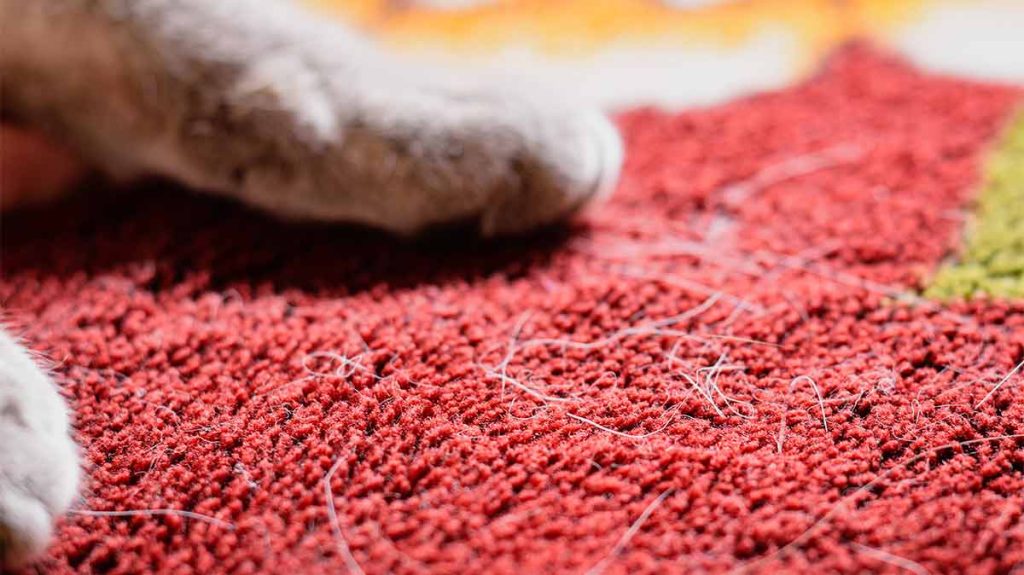
For anyone sharing a home with a dog or cat, this frustration never quite goes away. Pet hair weaves itself deep into carpet fibres, resisting every pass of the vacuum.
And it’s not purely a cosmetic problem either. Embedded fur traps odours, collects allergens, and turns your carpet into a dust magnet.
The truth is, vacuuming alone was never really designed for this. So, here’s a complete guide on how to get pet hair out of carpets once and for all.
Why should you remove pet hair from your carpet?
It’s tempting to write off pet fur as a basic mess, that thing you hurriedly clean right before company shows up and then happily ignore until someone’s ringing the doorbell again.
But here’s where it actually gets problematic: buried down below those carpet strands exists a concealed zone of fallen fur, pet dander, grime fragments, and irritant particles all matted together into a compressed, sunken layer that regular vacuum cleaners just can’t reach.
And it gets worse. Every step you take, each energetic dog zooming across the room, every cat pouncing from the furniture edge—they all kick that debris cloud floating right back into the atmosphere you’re pulling into your lungs.
For folks dealing with allergy problems or housing a champion shedder, this ongoing loop becomes a quiet, layered siege on your indoor air quality that deepens and multiplies over months and years.
The result? Odours that refuse to budge. Pet fur works like a tireless sponge, catching every odour it brushes past and clinging to those scents with unexpectedly stubborn tenacity.
Add Australian summer humidity into the mix, and you’ve created the perfect conditions for odours to intensify and embed themselves deeper into the carpet fibres. Standard air fresheners simply can’t compete with what’s trapped down there.
Not to mention, accumulated fur mats down the carpet pile, compressing the fibres and leaving your carpet looking flat, dull, and years older than it actually is. Foot traffic usually gets the blame, but built-up pet hair is often the real culprit.
Staying on top of removal, then, is about far more than appearances. It’s how you protect your air, your health, and the carpet itself.
Practical ways to remove pet hair from the carpet
So, what picks up pet hair the best? Tools made with rubber claim the number one spot, and there’s solid logic behind why they’ve earned that position.
Rubber creates a grip similar to static cling that drags buried hair up through the carpet weave, accessing layers that vacuum cleaners just give up on.
But rubber alone won’t solve everything, and the type of your carpet is also a factor. For instance, a dense, plush shag that swallows fur whole is operating on entirely different terms than a low-pile surface where hair at least stays within reach.
Layer in how deeply the hair is embedded and things get a little more complicated. Fur sitting loosely after a fresh shedding session is a completely different beast from hair that’s been driven deep into the fibres by weeks of foot traffic.
Essentially, to get pet hair out of carpet, knowing which approach a situation actually calls for is what separates a carpet that looks clean from one that actually is.
Rubber gloves
Before reaching for anything more specialised, check under your kitchen sink first. Those rubber gloves sitting forgotten beside your dish soap are, weirdly enough, among the best weapons you’ve got for yanking pet fur loose from deep within carpet strands.
Slip the gloves onto your hands, push down hard against the carpet pile, and move across it using brief, intentional dragging motions.
The rubber grips onto the fur instead of sliding past it, creating sufficient resistance to yank buried strands upwards and bunch them into tangles that peel off easily.
Dampening the gloves slightly takes things a step further. Moisture sharpens the grip and encourages hair to cling to the rubber surface with considerably more enthusiasm.
The word slightly is doing real work in that sentence, though.
Go beyond just surface-level wetness and that moisture seeps straight down into the carpet’s core, creating an entirely separate headache you didn’t bargain for.
During something like an average Australian summer—where sticky air hangs around and ventilation is non-existant—a soggy carpet becomes a brewing stink bomb just counting down the hours.
This technique is perfect for places where larger tools are basically useless like stairs, tight corners, or the narrow run along a skirting board. Rubber gloves are also quite good for removing dog hair.
Rubber broom
For anyone living with a heavy shedder and a generous stretch of carpet to match, this is the tool that consistently delivers where repeated vacuuming fails.
Your approach actually counts here. Ditch those broad, flowing passes you’d normally make across timber floors. When working a rubber broom, you’re dragging it back towards your body using quick, deliberate pulls. That focused force lets the rubber bristles properly penetrate down into the pile and grab what’s hiding there.
Each stroke generates friction and static against the carpet fibres, drawing embedded fur to the surface and rolling it into dense clumps that gather in front of the broom as you work. Nothing scatters, nothing redistributes.
Now you know that rubber brooms really do work for pet hair! Follow up with a vacuum afterwards and the difference will be difficult to ignore.
Shower or window squeegee
Unlike bristles that can slip around fibres, a flat blade of a squeegee trades precision for sheer friction.
As you move it towards you, that rubber edge creates enough force against the pile to coax hair to the top and gather it into neat rows.
The trick is commitment. This isn’t a gliding motion, but deliberate pressure, each stroke working against the pile with real weight behind it.
That’s what separates a squeegee from something that just moves hair around. Stubborn patches, the ones that have already outlasted multiple vacuum passes, suddenly surrender under this sustained friction.
Medium- to low-pile carpets are its sweet spot. Push into anything thicker and the blade starts losing traction.
Stiff-bristled brush
Rather than directly extracting hair by force, it rattles things into submission, breaking apart how fur tangles around separate fibres and shaking free whatever’s embedded deep beneath the carpet surface.
Your best bet is working in multiple directions with controlled pressure. But push too hard on delicate or looped carpets and you’re damaging, not cleaning.
Here’s the catch: used alone, it just moves hair around. The real magic happens when you vacuum immediately after. The loosened fur lifts away in a single pass.
Carpet rake for deeply embedded hair
A carpet rake’s fine tines are engineered to slip between fibres rather than comb across them. When used correctly—with gentle, deliberate pulls—it separates the pile in ways that expose fur buried too deep for other methods to handle.
Low-pile surfaces don’t offer enough depth for the rake to access. But if you’re dealing with plush or shag, this tool often retrieves what vacuums have been missing for weeks.
Run it through once, and your next vacuum pass will feel like you’re cleaning an entirely different carpet.
Damp microfibre mop or sponge
A microfibre mop or sponge that’s barely damp—we’re talking wrung-out-until-your-hands-hurt damp—generates just enough traction to pull loose hair into satisfying clumps as you drag it across the carpet. The friction does the heavy lifting; the moisture just makes it exponentially more effective.
Hair collects quickly and stays that way rather than scattered everywhere. For larger rooms, wrap a damp microfibre cloth around a broom head instead. You get the same effect across a bigger surface without the repetitive hand motions.
Remember not to overdue it with too much moisture to avoid mould or possible odours. Slightly damp means your fingers barely glisten when you wring it out.
A lint roller or duct tape wrapped around your hand
A lint roller works by pressing and lifting, not dragging. Short, deliberate presses followed by peels is where the real collection happens.
It’s tedious across large areas but quite effective on edges, stair transitions, and the narrow spaces where carpet meets furniture.
Don’t have a lint roller? Duct tape wrapped sticky-side out around your hand works just as well. The adhesive principle remains the same regardless of whether you’re using a roller or improvising with tape.
Vacuuming with a proper attachment
Not all machines are built equally for extracting embedded fur, and generic suction alone rarely cuts it for serious shedding.
A motorised brush roll is what you’re after. These actively agitate the pile while suction pulls, a combination that basic vacuums can’t replicate.
Pet-specific attachments and upholstery tools exist because they solve problems standard heads simply ignore. If your machine doesn’t have these, you’re working with a handicap before you even start.
Speed changes everything too. Slow, deliberate passes give the brush roll time to actually engage with embedded fur. Cross-hatching your strokes (one direction, then perpendicular) forces the suction to approach hair from different angles, catching what a single-direction pass would miss entirely.
Baking soda before vacuuming
When you sprinkle it across your carpet, the powder settles into the pile and begins neutralising the odour compounds clinging to embedded fur. At the same time, it shifts the surface chemistry just enough that fur loses its grip on the fibres.
Let it sit for 10 to 15 minutes, then vacuum with purpose. You’ll collect more hair than a standard pass would ever touch, and perhaps more importantly, your carpet will cease functioning as an ambient pet smell diffuser.
Restraint matters more than quantity here. A light scatter works better than generous coverage. Too much becomes a residue problem, and delicate carpets deserve a test patch first.
For most situations though, it’s one of the few methods that addresses both the visible problem and the one you can only smell.
Stop wrestling with embedded fur
Book our carpet cleaning service for fresh and clean results
Why is pet hair so hard to get out of carpet?
Pet hair is deceptively engineered to stay put. It’s light enough to float and drift, yet textured enough that it wraps around carpet fibres instead of rolling across them. High-pile and twist carpets make this worse by offering countless anchor points where hair can nestle and tangle.
Then there’s foot traffic. Every step you take drives embedded hair deeper into the pile, compressing it further down where suction can’t follow. The hair becomes progressively more entrenched the longer it stays there.
Static electricity compounds everything. In dry homes or during winter heating season, that invisible electrical charge makes fur cling aggressively to fibres.
Is it better to sweep or vacuum pet hair?
On hard floors, sweeping actually works. On carpets, not so much.
A traditional bristle broom doesn’t collect pet hair—it redistributes it. Fine strands drift across the surface like tumbleweeds. Coarser ones get shoved deeper into carpet fibres where they’ll mock you until the end of time. You’re not cleaning. You’re giving the hair a tour of your living room.
This distinction exists because most people think brooms are interchangeable tools. They’re not. A rubber broom creates friction that actually grips hair instead of shooing it elsewhere. Suddenly sweeping becomes a legitimate option again.
The hierarchy is straightforward: for carpets, vacuuming wins without contest. A standard bristle broom on carpet is so useless you’d get equivalent results by staring at the floor intensely and willing the hair to leave. You’re better off saving your energy.
Rubber brooms earn their keep on hard surfaces, where they excel at gathering hair into actual piles you can dispose of. When it comes to carpets, they function as a preliminary pass before you vacuum, loosening embedded hair so your vacuum can actually reach it. It’s a supporting role, not the headline act.
Prevent pet hair from building up in your carpet
Removal methods work, but they’re reactive. The real advantage comes from stopping hair before it becomes a problem in the first place:
- Frequent pet grooming – Regular brushing catches loosening fur before gravity deposits it naturally all over your carpet, especially when it’s peak shedding seasons.
- Washable area rugs over high-traffic zones – Place these where your pet rests, eats, or travels most frequently. Rugs catch hair before it embeds into fitted carpet fibres, and they’re infinitely easier to clean than your main carpet. Shake them out regularly or toss them in the wash.
- Regular vacuum schedule – Vacuuming frequently prevents hair from getting driven deeper by foot traffic. If you’ve got a serious shedder, hit the floors a few times a week instead of waiting for one exhausting weekly purge.
- Air purifier with HEPA filter – These trap airborne hair and dander before gravity delivers them into your carpet. They’re not a substitute for actual cleaning, but they cut down on what gets woven into the fibres in the first place—and as a bonus, the air stops tasting like you live in a kennel.
When DIY methods may not be enough…
There’s a point where your tools stop delivering results.
Hair returns in the same spots despite repeated cleaning. Odours linger even after baking soda treatments. The pile looks permanently flattened and matted. Allergy symptoms worsen as you clean more frequently.
These are signals that your carpet has accumulated beyond what household methods can extract.
That’s when you call in professionals with hot water extraction equipment. They heat water to the point where it actually penetrates the carpet pile, then vacuum out everything buried down there—the hair, the dander, the mystery grime—that your home tools can’t tackle no matter how motivated you are.
For residences sheltering heavy-duty shedders, annual or semi-annual professional service blocks progressive wear and prolongs the functional years you’ll get from your flooring.
Tired of cleaning the same spots over and over?
Let us uncover the carpet you forgot was underneath
Takeaways
- Pet fur traps dust and dander while releasing unpleasant smells and slowly damaging your floor covering. Clearing it out regularly means you’re breathing cleaner air and getting years more out of the carpet.
- Tools with rubber surfaces—cleaning gloves, specialty brooms, or window squeegees—generate a static grip that literally drags stubborn fur up from where it’s tangled deep in the fibres.
- Brush your pets often, throw down washable rugs in their favourite zones, and run your vacuum frequently so hair never gets the chance to weave itself into the carpet.
- When your go-to methods quit working like they used to, bringing in professional steam cleaners becomes your only way forward. If odours linger and fur keeps reappearing no matter what you try, the issue is buried too deep for anything you’ve got at home to fix.